We provide advisory and training services to boards focused on increasing board effectiveness.

What differentiates Boardelta?

Its’ track record, approach and value for money and the fact that the work is delivered by a highly experienced chair who is a thought leader in Board effectiveness and governance.


Boardelta has extensive experience across a wide range of sectors, sizes and types of organisations from start-ups to multi-billion dollar corporates. 


Boardelta is also a social enterprise, its work in the social sector and for smaller organisations is heavily discounted to enable social sector organisations to afford premium quality advice and development. A significant proportion of revenue is donated to four charities Boardelta’s founder is closely associated with.

About

Patrick Dunne OBE

Chair of board consultancy Boardelta and the charities The Royal Voluntary Service and Education Sub Saharan Africa (ESSA).


Patrick’s executi
ve experience was with Air Products and with FTSE 100 private equity 3i Group plc where he was Communications Director, a member of its Operating committee and Chair of its Operational Risk forum.


  • Read More ...

    He has supported Chairs across a wide range of sectors in Europe, Africa, Asia and North America in transforming the effectiveness of their boards through Boardelta. A member of the Higgs review and author of the award winning “Boards” he has helped to establish many  successful courses on board skills over the last twenty years including for the BVCA, Invest Europe and the Financial Times. 


    Patrick has a passion for education and is a former member of the General Council of the University of Warwick, a Visiting Professor at Cranfield School of Management, and an Associate Fellow at Warwick Business School. He is also a former Chair of the Oversight Board for the Chartered Management Consultant and former Trustee of the Chartered  Management Institute.


    He has a degree in Mathematics and Statistics from the University of Warwick and an MBA from Cranfield and is a Fellow of the Royal Statistical Society.


    As the founder of Warwick in Africa, ESSA and EY Foundation and former Chair of Leap Confronting Conflict he is also a serial social entrepreneur and was awarded an OBE in the  King’s 2023 Birthday Honours list for services to charity and philanthropy in Africa and the UK.

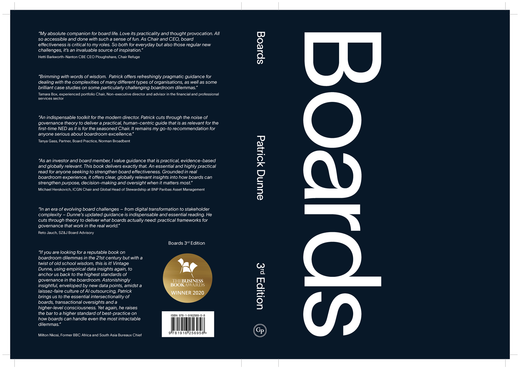
BOARDS 3RD EDITION

By Patrick Dunne, OBE


Boards, the 3rd edition of the award-winning book, provides a practical, realistic, thought-provoking and useful guide to life as a board member.

Boards has become the 'Go To' companion book for board members around the world as well as those working with boards or aspiring to be a board member , since it was published as the pandemic was breaking in early 2020.

Its structure is based on Patrick Dunne's "Purpose, People, Process" model for board effectiveness, with highly practical frameworks and tips and an engaging series of real life dilemmas that has proven to be a winning format.

This new edition is a substantial update reflecting what has changed for boards since the start of the decade. Also, it contains thought on what might change as a result of a world in flux, especially with regard to decision making.

There is lots of new new content in each section as well as four new dilemmas. The new dilemmas cover the challenges of shifting the way decision are made, the opportunities and challenges of having a Next Generation Board, how to navigate an acquisition gone wrong as well as a board pirouetting over its approach to Diversity, Equality and Inclusion.

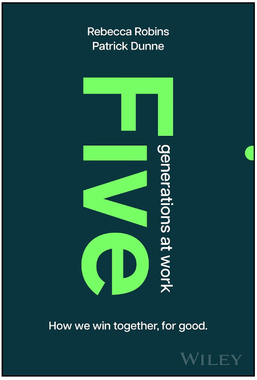
Five Generations at Work: How we win together, for good explores how to maximise the dynamics of our generational diversity to create more collaborative and competitive organisations. An energising and pragmatic read, this book unpacks six years of research and work with organisations and individuals who are taking progressive action to lead from lenses versus labels, evidencing the value of generational diversity.

For the first time in history, we have up to five generations at work. In the context of a world in flux and polycrisis, our diversity is a powerful force multiplier for good, if we debunk the stereotypes and know how to unlock it.

Advisory

Boardelta’s advisory services, by their very nature, are highly tailored to the client’s specific situation but have included supporting: 

  • Chairs in bringing about a transformation in board effectiveness. 
  • Chairs and CEOs to improve the quality of interaction between the Board and the executive leadership. 
  • Chairs and CEOs in achieving alignment between stakeholders 
  • A board through major challenges of a financial, regulatory or organisational nature.
  • Helping VC or PE investors establish a consistent and effective model and policies for the way that they compose and interact with the Boards of portfolio companies. 
  • Through facilitating simulations of challenging or complex situations to enhance board resilience. These have ranged from resolution process board meetings for major banks to industrial accidents or preparing for difficult strategic choices or crisis situations. 
  • Founders and investors to establish boards as well as the core processes to ensure high performance.

Training

Boardelta’s training is rooted in the characteristics of high performing boards, tailored to the relevant context and culture and delivered in a highly participative, practical and engaging way.


Sessions range from one hour focussed virtual sessions on a specific topic to two-day intensive ones covering a broader range of topics.


Recent topics have included:

  • Characteristics of high performing Boards
  • Behavioural Dynamics
  • High performing interaction between Board and executive
  • Decision making
  • Data Savvy Boards
  • Managing conflict
  • Board Sub-committees
  • Simulations

Thought Leadership

At 3i Patrick built a highly successful series of “People” Programmes to enhance the quality of 3i’s portfolio boards and management teams across the world. He was also a pioneer in peer-based Board training and helped to establish a range of leading board effectiveness training programmes including those for the Financial Times, the BVCA and Invest Europe.


He was also a member of the Higgs Review group helping to shape the governance of major listed companies.


Patrick's articles and podcasts for a range of organisations also provide a regular flow of thought provoking content for Board members and leadership teams.

Learn more

This is a paragraph. Writing in paragraphs lets visitors find what they are looking for quickly and easily.

This is a paragraph. Writing in paragraphs lets visitors find what they are looking for quickly and easily.

Learn more

Chairs in bringing about a transformation in board effectiveness. Chairs and CEOs in achieving alignment between stakeholders

Chairs and CEOs to improve the quality of interaction between the Board and the executive leadership.


A board through major challenges of a financial, regulatory or organisational nature.


Boardelta Insights

June 5, 2026
As the season to be jolly swiftly turned into the season to be sorry at the start of this year, the downside of those basic human motivations of sex, greed and fear became ever more present in the media. Intermingled with the sordid and sensational has been a steady flow of organisational and leadership “ fessing up ”. Apologies for errors of judgement, failure to exercise duty of care, poor process, cyber-attacks and so on. As well as the sometimes humorous, yet more frequently jarring trend, highlighted in a recent article in the Indian Times. The corporate faux apology, in essence saying that we apologise for our products being too good. Many of these situations further erode already low levels of Trust in leaders and their organisations. Not simply because of what happened, but also because of how those responsible have responded and treated those affected. Undoubtedly there are some that have malicious intent, have had a humility bypass or lack remorse, but not always. Sometimes, even those with the best of intents just don’t deal with challenging situations well. Last year’s Edelman Trust Barometer report highlighted that: “People feel institutional leaders are deliberately misleading them. A poor apology—seen as arrogant, defensive, or insincere—validates these feelings, transforming a, singular failure into a "generalized resentment". It doesn’t seem to have got any better, and as a result, I wondered if there was any science around fessing up and apologising. A “ Fessology ” perhaps to guide us when trying to get it right, whether the cause is self- inflicted, inherited or we’re simply the person who has ended up having to deal with it. The only reference to “ Fessology ” that I could find was a boogie-woogie piano instrumental by the Ludwig Seuss Band, on their 2017 album Ludwig Seuss and the Boogiemen . A tribute to the "Fess"—New Orleans piano legend Professor Longhair. So, I hereby coin the phrase “ Fessology ” in this context and share a collection of non boogie-woogie or academically rigorous thoughts on fessing up and apologising. Firstly, what is the distinction between the two? The slang expression “ Fessing up ” is all about the confession. Acknowledging culpability and responsibility for something we or our organisation has done that has or will adversely affect others. Wonder if the omission of the “ con ” is intentional or simply for convenience! These days an apology to those impacted generally goes further. It will include fessing up but typically also involve a message of remorse, describe how the remedy will be provided, how lessons will be learnt and actions taken to minimise the probability and impact of it happening again. From a board’s perspective in such situations it is worth stepping back and using the tried and tested “ Purpose, People, Process ” model, from Boards, and asking a few basic questions. Are we clear what we are trying to achieve through fessing up and apologising? Have we got the right people doing it, and are they working together in the right way, and have we got a good robust underpinning process to be effective and efficient in how we do it? We also need to take account of the influence that the specific context will have on what we do and how we do it. As well as remember what seems to differentiate those doing a good or bad job of it. The influence of the context? The nature of what we need to fess up or apologise for clearly has an influence. Not least, whether we were personally responsible for what happened or not. Chairs and CEOs sometimes end up apologising for the actions of their predecessors or those in the organisation. Other factors of significance in shaping a response will include the scale and nature of impact on those we are apologising to, and whether or not the situation is or is likely to involve some or all of the following: ● Criminal or civil law proceedings ● Breaches of company law and regulation or other compliance issues ● Regulatory breaches or requires regulatory investigation ● Financial loss to others and the organisation ● Breaches of agreements with investors, unions or strategic partners etc. ● Reputational damage to others as well as ourselves, individually or collectively Other contextual factors are the respect for the leader and the organisation, the strength of their relationships, as well as their Resilience. As will their track record in dealing with previous challenges. A well earnt default to trust, which although should never be taken for granted, can be a powerful friend when things go wrong. Whereas a deficit of trust will almost certainly be a considerable constraint. Classic situations where the need to fess up and apologise include: ● Individual or collective, ethical or misconduct issues ● Poor strategic choices ● Product or service failures ● Effects of system failures, cyber-attacks, data breaches or other technical issues. ● Governance failures ● Poor or mis communications Cultural context is another important factor, as noted below. As is the culture of the sector. The airline industry’s “ Black-Box ” culture perhaps being the most distinctive. Mathew Syed’s brilliant book “ Black Box Thinking ” extols the virtues of this and suggests that more of us could use the principles of transparency and, while retaining accountability, develop learning rather than blame cultures. The rise in the importance of social media and an understanding of the power of influencers is another thing to take into account. Not least because of the speed with which news and opinions are spread and amplified as well as the variable reliability of content. For more on this aspect its worth reading the St Gallen Review article on how to say sorry on social media What differentiates those who get it right from those who don’t? The starting point for getting it right is a determination to get the facts and to gain a rapid understanding of how those facts might be perceived and interpreted by the key stakeholders involved. We are likely to have contingency and crisis communication plans that we can draw upon and adapt to the specific circumstances. Increasingly Boards may have also conducted Simulations. One popular one at the moment is simulating the board meeting immediately following a cyber-attack. Always recognising that the specifics may be different when something happens, but you will be more prepared and higher functioning as a team. When asked about the qualities to look for in Board members, and leaders more generally, my response usually places emphasis on “ good judgement, strong interpersonal skills and finely tuned antennae ”. Three qualities especially useful in responding to a situation where we need to acknowledge that something is wrong and to apologise. They help us to keep things in Perspective. In the heat of the moment, they will also help us to be evidence based, solutions focused and understand the likely perceptions of key stakeholders, as well as to inform and deliver more effective communications. Gary Goodenough, Head of UKI for SAP Concur Enterprise, makes the point that a leader's biggest asset in times of crisis is access to data and visibility. “Without the facts, it’s hard for a leader to assess the situation at hand and fully understand the magnitude of what has potentially gone wrong. This is where having data and visibility is vital, so leaders can determine what has happened, own up to it if required, and prevent it from happening again. Data gives leaders the power to be agile, pivot approaches when there are bumps along the road, and better weather the storm.” Those who get it right often start by saying something along the lines of “ I want to say sorry, tell you what happened and what we are doing about it ” Then do just that, conveying genuine empathy and engendering trust not just in their integrity but also their competence to put things right. I wondered if it made a difference whether the word “I” or “We” was used and found an article on Conversation.com about a study from Associate Professor Prachi Galla and professors Jennifer H. Tatara and Courtney B. Peters. They analysed 224 corporate apologies between 1996 and 2023, tracking unusual stock returns around apology announcements linking them to how CEOs framed their statements. What they found was that “CEOs who said “I apologize” often saw short-term stock returns rise by a statistically significant amount. CEOs who said “We apologize” saw no such effect. Saying “I apologize” lessens the market penalty by roughly 86%, we found.” Their conclusion was “that markets reward leaders who take individual responsibility.” In general, the CEO will be the lead spokesperson and external face of dealing with things. However, if the CEO is going as a result of what has happened, then the Chair will probably take the lead. The most regularly cited academic paper I could find on the topic is Six elements of an effective apology according to Science from Professor Roy Lewicki and colleagues from Ohio State. According to their two experiments with a total sample of 755, these six things were highlighted these six things: ● Expression of regret ● Explanation of what went wrong ● Acknowledgement of responsibility ● Declaration of repentance ● Offer of repair ● Request for forgiveness Their findings showed that the most important of these was acknowledgement of responsibility, followed by an offer of repair. The least was requesting for forgiveness. Those who get it right also avoid the surprisingly common half-apology, along the lines of “ I'm sorry the choice of some of my words has caused some people offence ”. This demonstrates a lack of empathy as well as engenders a sense that the person saying it doesn’t really think they said anything wrong in the first place. Peleton’s 2019 “ We’re disappointed in how some people misinterpreted our commercial ” was a fine example of this. Some cynically might say that this is smart as it moves criticism away from what you did to what you said. However, my feeling is that it compounds a negative and further undermines trust, which isn’t that smart in the long run. Those who get it right are well on top of the legal risks, recognising the far higher risks and costs in undermining trust associated with the half-apology. They also “ own the tone ” and strike the right chord with their language. It’s frequently noted that there are big differences between the way that apologies are viewed and delivered between the East and West, and that Japanese culture has the most sophisticated and serious approach to apology. Sumimasen's Story of the Japanese apology culture notes that an apology is: “More than just saying you’re sorry — it’s about etiquette, and letting others know that you are meditating on what went wrong, and not merely speaking the prescribed phrases. It has become part of Japanese society and is applied across the board, by individuals, public figures, celebrities, corporations, even governments. “ Sumimasen also notes that it isn’t just about the words you use, body language is just as important: “Bowing is a popular form of respect in many East Asian cultures, including Japan. When it comes to bowing, there are several degrees of formality, just as there are with language. A bow accompanied by an apology will, on average, linger longer and be deeper than any other bow. A full ninety-degree bow by company officials in response to a crisis will last five seconds or more.” Back to the UK where BBC Radio 4’s When it hits the fan podcast with David Yelland and Simon Lewis recently suggested that the age of spin seems to have had its day, perhaps due to a less trusting public and social media. An example of an attempted spin going wrong was the legendary UK Water Companies Apology in 2023, which, rather cheerily for such communications, apologised on behalf of the industry for a large number of sewage spills and aimed to shift the mood by announcing a £10bn investment plan to put things right. However. It didn’t take long for consumer groups, journalists and others to realise that increased water bills would be a significant contributor to funding it. Outrage ensued and the sector and many of the individual companies have struggled to recover confidence in it as a result. On that last point, speed of response to something going wrong and willingness to do so, does seem to be a success factor. Not rushed or panicked but calm, sincere and measured. Gary Goodenough said: “Although we are in an age where social media and AI has the potential to exacerbate issues, the good news is that with this comes new technology to support businesses. Our AI-powered auditing solution, Verify, is a perfect example of this. This technology uses AI to spot fraudulent AI-generated receipts, helping customers identify thousands of AI-generated receipts globally and aiding in deterring expense fraud. For leaders, having the right systems in place to track data and signal when something is awry is invaluable.” In summary, preparation clearly helps. As does having access to expert legal and PR advice but, as emphasised above, it’s the quality of judgement, interpersonal skills and antennae that will be the ultimate determinant of success. And what’s success? Well the best apology is often noticeably changed behaviour. Patrick Dunne OBE Experienced Chair, author of the award-winning book Boards and co-author of Five Generations at Work: How We Win Together, For Good This article has been sponsored by SAP Concur industry-leading technology that automates travel, expense and invoice spend processes. The fee will be donated to ESSA, a charity which is using evidence to transform educational outcomes through systemic change across Africa.
June 5, 2026
A fine sense of judgement, superb interpersonal skills and well-tuned antennae are three of the defining characteristics of high performing leaders. Many things underpin and enrich these characteristics. Not least the power of a broader and deeper perspective to boost the quality of decision making, help us spot danger, maximise the probability of successful implementation, engage others and enable us to have a happier and less stressful time. Instinct and perspective allow us to know where we and others are, as well as understand the context and terrain. And, as for owls, they can help us to combine a sharp focus on what we want to achieve with the ability to horizon scan and to be aware of opportunities and threats that others may miss. They can also help to mitigate or compensate for weakness in other areas. An owl’s exceptionally mobile neck more than compensates for immobile eyes. Allowing their heads to rotate up to 270 degrees and enabling them to pinpoint prey with precision. Owls are also far-sighted, seeing things more clearly at a distance. They also bob their heads up and down to have multiple visions of an object. Interestingly, characteristics adopted in many of the increasingly sophisticated robots used in automated manufacturing processes. So, how can we be owl-like and benefit from increased perspective without breaking our necks? What exactly are these benefits in a decision-making and leadership context? How do we manage to get alignment when we have different perspectives and how might we develop our ability to have a broader and deeper perspective? Benefits: According to various AI sources, five common benefits arise from having a broader and deeper perspective: ● Improved problem-solving and creativity: Thinking from different perspectives can prompt deeper, more sophisticated thinking. Resulting in greater creativity and better outcomes. ● Better decision-making: Understanding the " bigger picture " enables more effective prioritisation and objective setting. It can also help in balancing short- and long-term benefits and balancing the needs of different stakeholders. ● Enhanced cooperation and collaboration: Gaining the perspectives of different people within a group can help foster better cooperation and coordination enabling members to understand and take account of each other's intentions and viewpoints. It may also reduce the risk of dependence upon a single perceived " expert ", whether they are or aren’t a real expert. ● Reduced negative biases: Perspective can help you question unhelpful assumptions and reframe situations to see possibilities rather than limitations. It may also prevent a " negative filter " caused by stress and help us to put things in context and assess their true significance. ● Emotional balance and regulation: Stepping back from stressful or negative situations can make it easier to manage our emotions, to respond rather than react and to avoid being overwhelmed. It can also lead to greater enjoyment and a more relaxed state, particularly in high-pressure situations. A good list, to which I would add another five: ● Knowing where we and others are on an issue before we decide. ● Greater buy-in for implementing decisions. ● Better preparedness to communicate and to deal with objections when decisions aren’t in the interests of all stakeholders. ● Increased self-awareness and ability to adapt our own views because of those of others. ● Increased legitimacy for the decision makers. We must also be conscious of the risks in aiming to broaden and deepen our perspectives. These include: ● Procrastination and failure to seize opportunities quickly enough. ● Trying to please everyone and making sub-optimal decisions. ● Managing expectations. The joy of inclusion can quickly be replaced with frustration if those whose perspectives are sought end up feeling that: “ You asked me what I thought and then ignored it ”. Knowing where we and others are: Gary Goodenough, Head of the UK and Ireland Region for SAP Concur Enterprise, believes lack of visibility is the biggest risk to businesses. “We’re in such a fast-moving world with profound volatility in key variables as well as perspectives on the outlook. So, it is even more vital to have the data to help us know exactly where we are, and where we are likely to be, given current commitments and our expected trajectory. “We’re seeing increasing demand for our audit capabilities as businesses need greater insight into their finances to make agile decisions.” On top of having the data, we need to be able to differentiate between facts and interpretations, to listen to what people think as well as what they say and to take the time to understand the emotions behind viewpoints. As well as creating the right environment including psychological safety so that people feel free to express different perspectives, to challenge and to admit mistakes before, during or after meetings, makes this easier. Telling people that it is a safe environment isn’t enough. In the “ Boards ” book, I referred to movie mogul Sam Goldywn’s quote “ I want you all to tell me what you think, even if it costs you your job ”. Psychological safety has to be real. We must also remember that we and others don’t always act in our own best interests. For all sorts of reasons, including poorly thought through perspectives, because of the influence of the eloquent but wrong or because we project misguided views onto others and don’t hear what they say. It helps a great deal to be actively open-minded and to be an active listener. Open-minded people are prepared to change their view if new information is presented to them. Whereas the actively open-minded go further. When a decision is coming up, they won’t just rely upon what is presented to them but will seek out additional information and have their antennae up for relevant information to calibrate what they will be presented with. These are all especially helpful things when Chairing and trying to ensure that we not only make the right decision, but that it has the commitment and buy-in as well as the resources and relationships necessary for that decision to be successfully implemented. Developing a broader or deeper perspective: The Socratic ladder is an enduring approach to broadening or deepening our perspective. Essentially, it simply suggests that before a decision or when we are likely to be answering challenges to our thinking or proposals, that we prepare questions under the following headings: ● For clarification. ● To probe assumptions. ● To probe reasons and evidence. ● About viewpoints and perspectives. ● To probe implications and consequences. ● About the question itself. A good discipline for developing critical thinking. In calibrating views that we or others have, we need to be aware that we don't always see or hear the same thing as others. Testing understanding and what people have heard or will take away from a conversation is therefore useful. A read of the late Daniel Kahneman’s brilliant book “ Thinking fast and slow ” can also help us bust inherent anchoring, confirmatory, mirroring, recency and other common biases. All things which can obscure our view and cloud our judgement. His other book “ Noise ”, co-authored with Oliver Sibony and Cass R.Sunstein, looks at the influence of noise in decisions and how to avoid flaws in judgment arising from it. Tone, body language and the impact of first impressions all influence our ability to calibrate. Amongst many things, Robert Sapolsky’s fascinating book “ Behave ” explores how first impressions are often formed in a fraction of a second at a subconscious, automatic level. These rapid neural responses can trigger fear or hostility toward perceived “ others " before the logical part of the brain has a chance to process the information. In a time-pressured world we may not always find it easy to take the time to calibrate our views. The use of AI and its strength in synthesising multiple sources of information has the power to boost or reduce our ability to calibrate. AI’s efficiency and short snappy summaries are incredible. Yet we aren’t always aware of the root sources of information in them or of the weighting of views and information. At this stage, AI usually summarises the information that is out there and often, sadly, a small number of extreme or negative views can sometimes distort the balance. Incidentally, one of the many quotes attributed to Socrates which is also relevant, is that “ It’s easier to win an argument than to make the right decision ”. At some point you need to synthesise views and make a call. If you are the Chair, the responsibility falls to you to enable the Board to agree on the right way forward with as much alignment as possible. Achieving alignment from different perspectives An image from “Boards” on alignment that I often use in leadership and board training is:
June 5, 2026
“Instinct, Observation, Preparation”
June 5, 2026
It feels as if there is a significant deficit of trust in our world. Whether that’s at an individual, organisational or institutional level. Or in commonly held beliefs or ways of doing things. These feelings are backed up and perhaps amplified by the evidence of an increasingly divided and divisive world. The 2025 Edelman Trust Barometer provides some clear evidence of this. The impunity with which those who betray trust placed in them reinforces and contributes to this unease. But what do we mean by trust? Why does it matter? How can we build, nurture and restore trust? How can we as individual leaders play our part in helping us to move from this fragile place to a better place. Not somewhere characterised by blind faith or complicit loyalty rooted in power differentials, but where trust is respected, highly-prized, is striven for and is the default place to aim for. What do we mean by trust? Trust has many dimensions. Most obviously, “Integrity”. We trust what you say, your motives, intentions, values and judgement and that we can rely upon you to do or say the right the thing. Even if it costs you in financial, positional, reputational or social credits terms. “Competence” is another. We, trust you have the knowledge, skills and behaviours to deliver. A classic example being the trust we place in health or legal systems and those who work in them to deliver the best outcomes for us. Trust in the process and that it will not only be competent at delivering the right outcomes but also be and feel to be a “Fair Process” is another dimension. Renee Mauborgne and Kim W Chan’s brilliant paper “Fair Process- Managing in the Knowledge Economy” has some valuable insights and tips on this and emphasises the importance of engagement, explanation and clarity of expectations. “Givens” or “Received Wisdoms” are another dimension of trust. This can be anything from the dollar’s correlation with Treasury yields which, as the FT reported was relied upon for a very long time until its recent break down, to popular sayings such as “Honesty is the best policy”. Frequently these beliefs have, or appear to have, evidence to back them up. Yet not always and sometimes things change to undermine their foundations. The FT’s Jemima Kelly’s entertaining article Mr Darcy and the Mandela effect provides good examples of this. Scrutiny aids trust yet sometimes can be misconstrued. Just because we scrutinise doesn't mean we don’t trust and just because we don't scrutinise doesn’t mean that we do. A board should be trusted to scrutinise. Cheer leading boards that fail to scrutinise betray the trust that stakeholders place in them. Cynical over-scrutinising boards that show no trust tend to fail to get the best out of their executives and are told far less than they need to know. Similarly, we also can’t make the assumption that just because someone has different objectives to us it means that we can't trust them.  SAP Concur's recent CFO Insight report evidenced this. When asked what they see as the top blockers when it comes to cross-functional collaboration, over half of both finance and IT leaders surveyed stated conflicting departmental priorities. While 57% of HR leaders felt it was insufficient data sharing and transparency. Gary Goodenough, SAP Concur’s Head of UKI, told me that “these figures show that by increasing trust between departments can result in better collaboration, shared decision making, and ultimately better business success.” Why does trust matter? Because we can move more swiftly and assuredly with it. We can play to strengths and support weaknesses and find it far easier to engender a common sense of purpose and motivation. It increases our mobilising, convening and negotiating power and we are more likely to gain advocacy and enlist support when we need it. Paul J Zak’s article, The Neuroscience of Trust, in the Harvard Business Review has some interesting statistics from research looking at the differences between high and low trust companies. “People at high-trust companies report 74% less stress, 106% more energy at work, 50% higher productivity, 13% fewer sick days, 76% more engagement, 29% more satisfaction with their lives, and 40% less burnout than people at low-trust companies.” Being a trusted investor has mattered a lot to legendary investor Warren Buffet. Pithy as ever in his 2024 annual meeting he quipped "I just like the feeling of being trusted". Being trusted feels good. Not to be trusted uncomfortable. Although clearly not for everyone these days! With trust we can also avoid some of the less obvious downsides when it is absent. In atmospheres of distrust we can easily project on to people inaccurate motives and intentions, take offence more easily and get distracted from what matters most. Alternatively, with trust if someone says something jarring, we tend to wonder why and it may open up a valuable conversation. Greater trust between those in different functions can also help maximise growth opportunities for a business – something frequently ignored. In fact, SAP Concur’s recent CFO Insights report found that only 9% of CFOs think growth leadership should be shared across the C-suite. This reluctance to share – or trust – other senior leaders could be counterproductive for a business. How do we build, nurture, or restore trust? A good starting point is to consider what level of trust is already there. Easier if there are high levels of individual and organisational self-awareness which in many cases may even be a pre-condition to building trust effectively. Thinking through the different dimensions of trust described above, may help us to identify where, with who and how we most need to build trust. Reflecting on past experience and behaviour and working out the “SAY:DO” gap also helps. We should never assume trust, especially because of our position or status. Just as arrogance is a judgement slayer it can also kill trust. Rarely can trust be microwaved it generally needs baking. The work I’ve done with boards on simulations of crises or of taking critical decisions can also be illuminating. The pressure of these situations often reveals the reality of relationships. As an investor its fairly easy to spot whether there is trust in a management team. The CFO’s face when a CEO is lying through their teeth normally gives a clue. The CEO who doesn’t have enough confidence in others in their team speaking or the reluctance to constructively challenge each other in front of others likewise. There are numerous ways to build trust. From basic relationship building and getting to know someone or a group over time, to more transactional or tasked based approaches which build trust through a track record of successful working together. The well-respected Roffey Park Institute, whose mission is rooted in breaking down barriers within workplaces and striving to create environments that are conducive to growth and success, has a useful image:
A group of men are sitting on a ledge overlooking a city.
March 19, 2025
Worrying is a perfectly natural thing to do and probably healthy to do for a little bit. Yet it’s thinking that helps us to make the best choices.
Reflective Powers What? Why? What? How?
December 5, 2024
Our capacity and capability to reflect is such a precious thing. Helping us to maximise potential as well as to minimise risk and to make life less stressful.
A man and a woman are dancing together.
September 6, 2024
As with many leadership words “Agility” has many meanings and components. Yet, when used, it is often mistakenly assumed that we all have the same understanding. Whether that’s about mental, physical, verbal or other forms of agility. Unsurprisingly, for a word applied to so many contexts, we frequently don’t.
A group of people are flying through the air in a circle.
June 13, 2024
Reflecting on things while traveling can be stimulating and so it proved in the beautiful hills near Maseru, Lesotho recently. The reason for my visit was to contribute to an Institute of Directors Lesotho event on governance, for which big thanks to their Chair, Selebalo Ntepe.
A conference room with a long table and chairs in an office building.
March 14, 2024
The proliferation of the "C" prefix to job titles has coincided with seismic changes in the way we lead, work and communicate as well as with generational shifts and changes in the power balance between functional leaders.
November 13, 2023
There’s more to arrogance than a humility bypass. It is important not to confuse a minor bout of over-confidence or healthy self confidence and assurance with a long-term and deep-rooted corrosive condition. A condition which ties a dead weight to the person suffering it and impacts those they come into contact with.
Show More

Dilemmas

To make space for a series of new dilemmas in the latest edition of the award winning book "Boards" the following dilemmas were not included. Given their popularity, especially with accompanying notes, Governance Publishing have kindly agreed that all of those from the second edition that are not in the third edition can be made freely available here.

Get in touch